When most organisations start caring about cloud spend, they gravitate toward the same predictable question: “How do we reduce costs?”
It feels logical. Cloud bills rise, finance worries, leadership becomes uncomfortable, and the knee-jerk reaction is to trim everything that looks unnecessary. But in cloud, cheaper doesn’t always mean smarter and that’s where the FinOps Paradox begins.
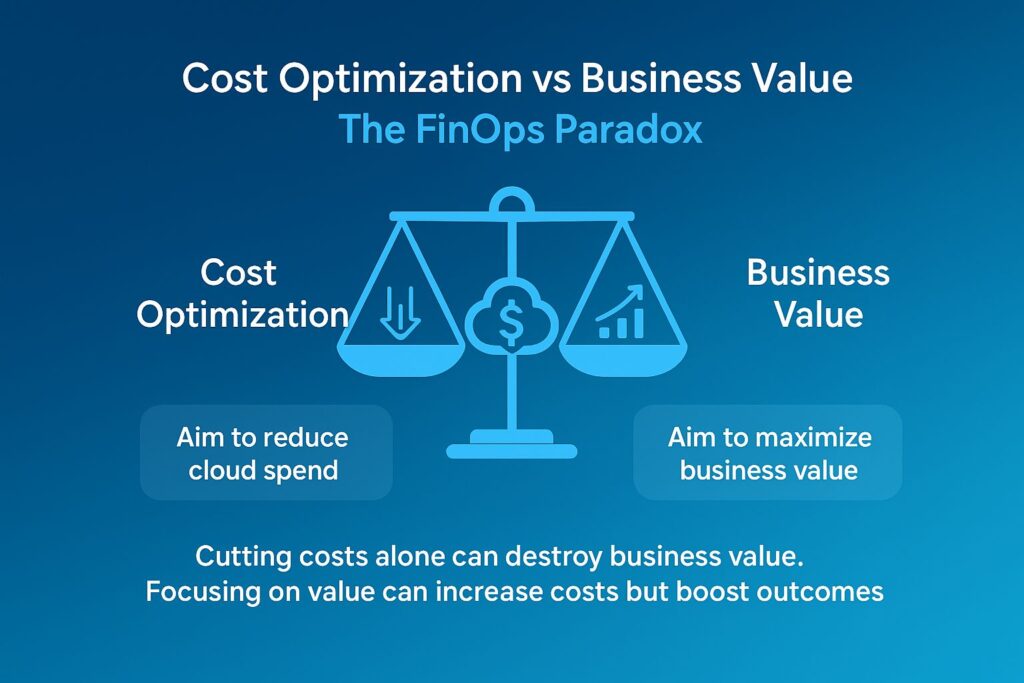
The reality is this: your goal isn’t to minimise cloud spend, it’s to maximise the value you get out of it. Some of the most innovative companies in the world spend more on cloud every year, yet their margins improve because the spend fuels velocity, performance, experiments, and customer experience. Value, not cost, is the real north star.
Why Cheaper Isn’t Always the Best Move
Let’s be honest, the moment someone sees a spike in cloud bills, the first instinct is to cut. Pause deployments. Downsize servers. Kill projects. But these actions often do more harm than good.
Shut down a staging environment and developers slow down. Right-size too aggressively and you risk performance drops during peak traffic. Reduce experimentation and suddenly your product roadmap starts slipping. You saved money, yes but at the cost of speed, quality, innovation, and customer trust.
That’s why FinOps encourages a more mature question: What business value did we unlock for this spend?
Because without context, cost is just a number.
Shifting from Cost-Centric to Value-Centric FinOps
The real transformation happens when teams stop obsessing over absolute cost and instead focus on the return on that cost. This is where unit economics enters the picture. Looking at cost per order, cost per API call, cost per active user, or cost per transaction suddenly paints a clearer picture. If your cloud bill goes up but your cost per transaction drops significantly, your business just became more efficient.
Then comes the efficiency lens, understanding whether you’re using your infrastructure well. Is CPU underutilised? Are storage tiers correctly mapped? Are commitments optimally planned? These insights turn previously emotional cost discussions into objective, actionable conversations.
But the heart of the FinOps Paradox lies in value realisation. Sometimes, the smartest decision is to spend more, on faster databases, better caching, improved observability, or high-performing compute because the business value they unlock far outweighs the cost. A system that loads faster converts better; ML models that run at scale improve recommendations; developer tooling accelerates release cycles. Saving money is easy. Unlocking value is strategic.
What Great Cloud Dashboards Should Reveal
When teams sit together to review cloud spend, the dashboards they see shape their alignment. A business-aligned view shows how much different product lines cost and what value they deliver. An efficiency view highlights waste without blaming developers. Forecasting dashboards reduce surprises and build predictability.
But the most powerful dashboards are the ones that show value: how latency improvements affected conversions, how new features impacted revenue, and how infrastructure decisions shaped customer experience. These are the dashboards that shift conversations from “Why is our bill high?” to “What did we gain from this investment?”
Cutting costs without understanding value is risky.
Spending without measuring value is equally risky.
FinOps sits in the middle helping organisations find balance between financial discipline and the freedom to innovate.
Your cloud bill is not an expense report; it’s a reflection of the choices your teams make, the ambitions your company carries, and the value your customers expect. The goal isn’t simply to spend less it’s to spend intentionally, and to scale with confidence, clarity, and purpose.
#FinOps #CloudCosts #CloudOptimization #BusinessValue #CloudStrategy #TechLeadership #CloudFinance #DigitalTransformation #UnitEconomics #CloudManagement #CFO #CTO #ProductStrategy