If you were managing cloud costs a few years ago, your “toolkit” was likely a terrifyingly large spreadsheet, a few native billing dashboards, and a strong cup of coffee. You spent your days playing detective, trying to figure out who launched that expensive server instance and why it was running on a Saturday.
But as we move into 2026, the landscape has shifted. The cloud is no longer just a place to store data; it is the engine of modern business. Consequently, the tools we use to manage it have had to evolve from reactive reporting to proactive engineering.
However, this isn’t about which specific software you should buy. Tools become obsolete. Features get deprecated. Vendor names change.
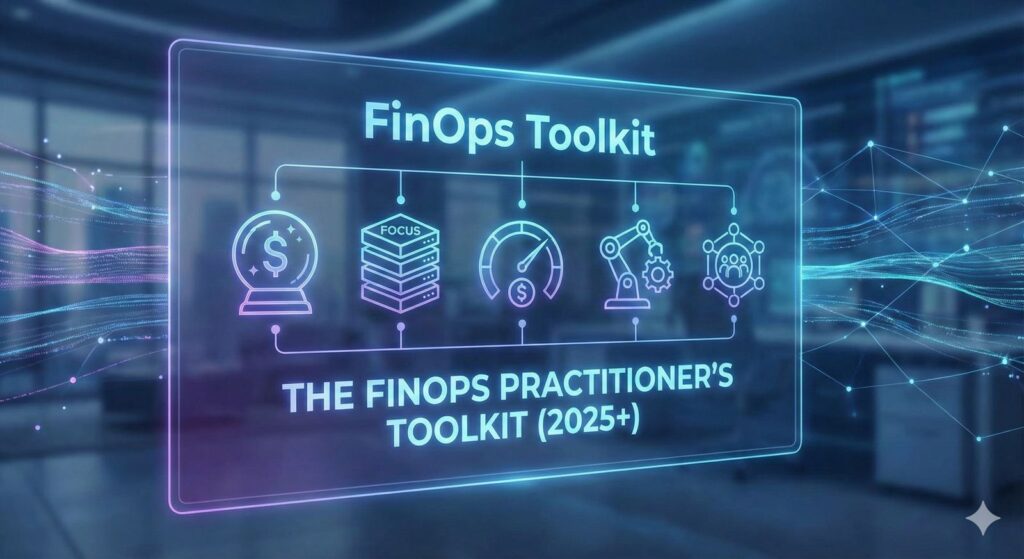
What doesn’t change are the capabilities you need to survive. Whether you are a solo practitioner or leading a Cloud Centre of Excellence, these are the five non-negotiable pillars of a modern FinOps toolkit.
1. The Crystal Ball (Pre-Deployment Estimation)
The most expensive cloud resource is the one you deployed without realising how much it would cost. For years, FinOps was a cleanup crew we waited for the bill to arrive, gasped at the total, and then scrambled to fix it.
The toolkit of the future requires a “Crystal Ball” a mechanism to see costs before they exist.
This means integrating cost estimation directly into the engineering workflow. When a developer writes code, they should receive feedback: “This change will increase our monthly spend by $500.” By shifting cost awareness to the moment of creation (often called “Shifting Left”), we stop treating cost as an accounting afterthought and start treating it like a technical metric, just like latency or uptime.
2. The Universal Translator (Data Normalisation)
One of the biggest headaches in cloud finance is the Tower of Babel problem. One cloud provider calls it a “Virtual Machine,” another calls it an “Instance,” and your internal finance team calls it “Fixed Asset Category B.”
You cannot optimise what you cannot compare.
Your toolkit needs a rigorous Standardisation Layer. This isn’t software; it’s a data strategy. It involves adopting a common schema (like the emerging FOCUS standards) that normalises billing data across multi-cloud environments. This capability allows you to look at a singular “pane of glass” where data is clean, consistent, and speaks the same language, regardless of where the infrastructure lives.
3. The Context Engine (Unit Economics)
A dashboard might tell you that your cloud bill went up by 20% last month. Panic ensues. But what if your user base grew by 40% in the same period? Suddenly, that “bad” news is actually a story of incredible efficiency.
This is where the “Context Engine” comes in.
A modern FinOps toolkit must move beyond raw dollar amounts. It needs to map cloud spend to business value. You need the ability to measure Unit Economics cost per transaction, cost per active user, or cost per feature deployment. When you can express cloud costs in terms of business profit, you stop being the “Cost Police” and start becoming a strategic advisor.
4. The Autopilot (Policy-Driven Automation)
In the early days of FinOps, we relied on “Nag-Ops” (Nagging–ops, cute huh) sending emails to engineers begging them to turn off unused resources. It was exhausting, and it rarely worked.
The 2026 toolkit relies on Automation.
We need to move from “Recommendations” to “Action.” If a development resource is untagged, the system shouldn’t send an email; it should quarantine the resource automatically. If a sandbox environment is running on the weekend, the system should shut it down. Your toolkit must include policy engines that enforce the guardrails you set, freeing up your brain power for strategy rather than policing.
5. The Cultural Bridge (Collaborative Visibility)
Finally, the most critical tool in your arsenal isn’t technical at all. It’s the mechanism you use to deliver information.
Engineers do not wake up excited to log into a finance portal. If your cost data lives in a siloed dashboard, it will be ignored. Your toolkit must include a Bridge a way to push data into the platforms where your teams already work (like Jira, Slack, or Teams).
When a team sees their cost efficiency score right next to their sprint velocity, they engage. When cost data becomes part of their daily stand-up, culture changes.
The Tool is Not the Strategy
It is tempting to think that buying the latest AI-powered platform will solve your cloud cost problems. It won’t.
A hammer is a useless tool if you don’t know how to build a house. The toolkit of 2026 is about frictionless intelligence. It’s about building a system where cost data flows seamlessly from the architect to the CFO, ensuring that every dollar spent is a dollar that drives value.
The question isn’t “What software are you buying?” The question is: “Is your toolkit built for the past, or is it ready for the future?” Feel free to reach to build your toolkit
#FinOps #CloudStrategy #TechLeadership #CloudFinance #DigitalTransformation