The Quiet Entry
In the early days, FinOps usually enters an organisation quietly.
It starts with a pilot here, a cost review there. One enthusiastic engineer and one worried finance partner. It often begins as a project a tactical response to a scary cloud bill or a quarterly budget overrun, and that’s okay. Almost everysuccessful FinOps journey begins in the trenches. But at some point, a question inevitably echoes through leadership meetings: “This is working… but how do we scale it?”
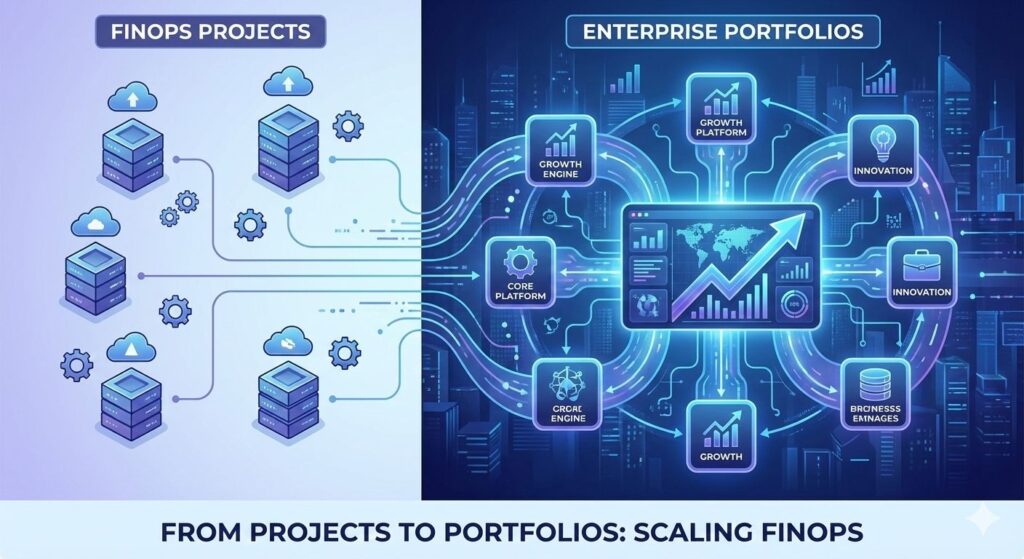
That is the moment FinOps must evolve. It must move from being a set of isolated initiatives into an enterprise-wide operating capability. It is the shift from managing a “village” to governing a “metropolis.”
Why “Project-Based” FinOps Fails
Project-based FinOps has a familiar, frustrating pattern:
- A tiger team identifies savings.
- A few optimisations are implemented.
- Costs come down for a quarter or two.
- Attention moves elsewhere.
- Spend quietly creeps back up.
No one did anything wrong. The problem isn’t execution it’s structure. Projects, by definition, have end dates. Cloud spend does not. As long as FinOps is treated like a one-time cleanup exercise, it will always lag behind the pace of cloud growth. Scaling FinOps means accepting a simple truth: cloud cost is not a problem to solve; it’s a system to manage.
From Initiatives to Operating Governance
Enterprise FinOps begins when organisations stop asking, “How much did we save?” and start asking, “How do we make cost-aware decisions repeatable?”
This is where governance enters not as a “gatekeeper” that slows things down, but as a “guardrail” that provides consistency. Effective governance doesn’t centralise decisions; it standardises how decisions are made. This includes:
- A Shared Language: A common cost allocation model everyone understands.
- Clear Ownership: Accountability at the team and portfolio levels.
- Predictable Rhythm: A standard review cadence that isn’t dependent on a “crisis.”
Instead of firefighting overruns, leaders gain Portfolio-level visibility. They move toward Decision Intelligenceunderstanding which products are scaling efficiently and which ones are unintentionally bleeding resources.
Thinking in Portfolios, Not Line Items
At enterprise scale, you cannot manage by looking at individual virtual machines. You have to live at the Portfolio Level. A portfolio view answers the strategic questions that actually move the needle:
- Which product lines deliver the highest revenue per cloud dollar?
- Which platforms are stable enough for long-term commitments?
- Where are we consciously overspending to accelerate growth?
This is where FinOps becomes a leadership tool. Instead of debating line items, executives can compare business outcomes across different portfolios growth engines, core platforms, and innovation bets all through a unified financial and operational lens.
The KPIs Leadership Actually Cares About
One of the biggest mistakes in scaled FinOps is flooding executives with operational noise. Leadership doesn’t need to know how many instances were right-sized; they need to know if the business is becoming more efficient.
At the enterprise level, your KPIs should answer three specific questions:
- Are we predictable? (Forecast accuracy and variance).
- Are we efficient? (Unit Economics: cost per customer or transaction).
- Are we aligned? (Spend mapped to business priorities and ROI).
When dashboards are framed this way, FinOps stops being a technical hurdle and becomes a value-realisation engine.
The Cultural Inflection Point
Here’s the real test of enterprise-scale FinOps: When a team makes a cloud decision, do they instinctively ask about cost and value without being prompted?
If the answer is yes, FinOps has moved beyond process into culture. This shift doesn’t come from tools alone. It comes from:
- Transparent Metrics: Everyone sees the same data.
- Shared Accountability: Engineers own their “Carbon and Cost” footprint.
- Trust: The belief that FinOps isn’t about cutting budgets but about funding the right things.
Intentionality at Scale
At scale, FinOps stops being a practice you “run” and becomes a management system you rely on. It helps leaders allocate capital more intelligently and balance efficiency with innovation without slowing teams down.
The organisations that succeed in the next era of cloud won’t be the ones with the lowest bills. They will be the ones where every cloud dollar is intentional. That is the real shift from managing projects to managing portfolios, with FinOps as the connective tissue in between.
#FinOps #CloudGovernance #PortfolioManagement #UnitEconomics #DigitalTransformation #CloudCost #Leadership #CloudStrategy #BusinessValue