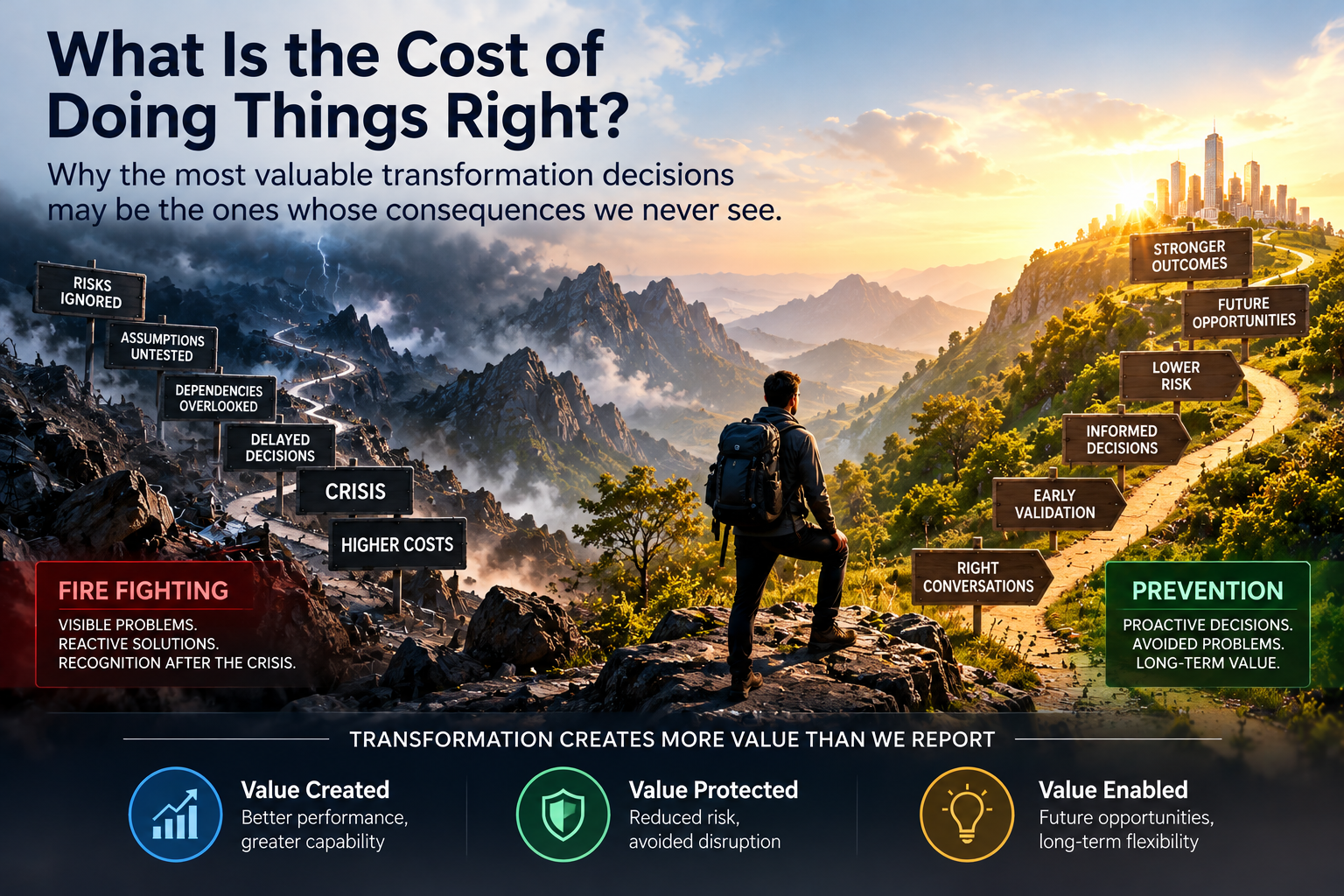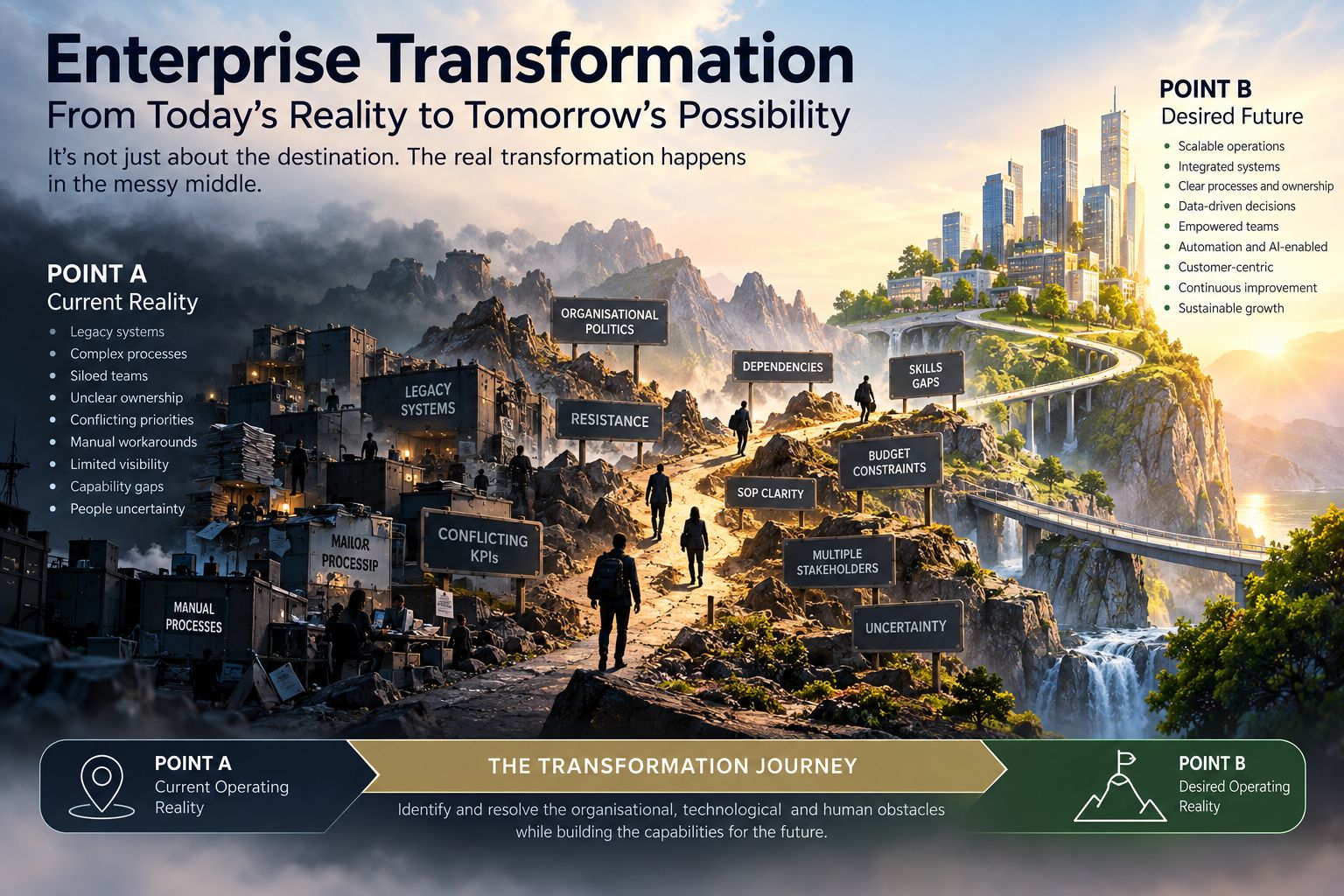
Why the most valuable transformation decisions may be the ones whose consequences we never see.
Sometimes, you need to step away to see clearly
It has been a little while since my last article.
I took a break to celebrate my father’s 75th birthday. Beyond the personal significance of the occasion, stepping away from my usual routine gave me an opportunity to reflect on something particularly relevant to enterprise transformation.
Sometimes, you need to zoom out before you can zoom in.
In transformation, we spend considerable time examining the details.
Project milestones. Dependencies. Risks. Escalations. Budgets. Resources. Governance. Stakeholder expectations.
All important.
But when we become too deeply involved in execution, we risk losing sight of a more fundamental question:
Are we making progress, or are we simply getting better at managing activity?
That distinction led me to another question.
What is the actual value of doing things right?
And perhaps more importantly, how do we demonstrate that value when the greatest benefit is something that never happened?
The paradox of successful prevention. Consider two enterprise transformation programmes. In the first, a major implementation encounters a critical issue. Systems are disrupted. Deadlines are threatened. Leadership becomes involved. Teams work around the clock.
Eventually, the crisis is resolved.
The organisation celebrates the recovery. The individuals involved receive recognition for their leadership, resilience and problem-solving capabilities.
Now consider another programme.
Six months before implementation, someone identifies a potential architectural weakness. The team challenges an assumption, revisits the design, engages the relevant stakeholders and resolves the underlying issue.
The implementation proceeds without disruption.
No crisis. No emergency steering committee. No extraordinary recovery effort. And quite possibly, no recognition.
Which programme demonstrated better transformation leadership?
The answer isn’t necessarily straightforward. The first team may have demonstrated exceptional crisis management. The second may have prevented a costly failure or addressed a risk that would never have materialised.
But the comparison reveals an important organisational blind spot.
We are often better at measuring the cost of failure than recognising the value of prevention.
The economics of doing things right, doing things right has a cost. Thorough discovery takes time. Architecture reviews require investment. Testing consumes resources. Stakeholder alignment involves difficult conversations. Training takes people away from their daily responsibilities. Governance can slow decisions and preventive interventions may require additional expenditure before their benefits become visible. When viewed individually, these activities can appear to be overhead.
The temptation is understandable.
Can we shorten discovery?
Reduce testing?
Skip another review?
Move faster?
After all, nothing has gone wrong yet.
But that is precisely the challenge.
The absence of a visible problem is not evidence that preventive work has no value. At the same time, more governance does not automatically mean better governance. An unnecessary approval, an excessive review or a control that adds little value can be just as damaging as insufficient oversight.
The objective should not be to eliminate every possible risk.
It should be to make proportionate decisions about which risks deserve attention, which interventions create value and where the cost of prevention is justified.
That requires judgment, not simply compliance with a process. Zooming out is a leadership responsibility. Transformation leaders operate at two levels.
At the operational level, they must understand what is happening.
What is delayed?
Which dependency is unresolved?
Where is the risk?
What decision is required?
Who is accountable?
This is the ability to zoom in.
But there is another responsibility.
To periodically step away from execution and ask:
Are we solving the right problem?
Does the original business case still hold?
Are we addressing root causes or managing symptoms?
Which decisions today could prevent significantly larger problems tomorrow?
What are we not seeing because our attention is consumed by immediate delivery?
This is the ability to zoom out.
Both perspectives are necessary. Zooming in without zooming out can produce excellent execution of the wrong priorities.
Zooming out without zooming in can produce compelling strategies that never survive operational reality.
The real skill lies in knowing when to change perspective and that brings us to another important distinction.
The number of decisions is not the measure of leadership
In complex programmes, decision-making can become a measure of activity.
How many issues were closed?
How many escalations were resolved?
How many approvals were obtained?
How many meetings resulted in decisions?
These measures have operational value.
But they do not necessarily tell us whether the right decisions were made.
A transformation leader might make twenty decisions in a day that keep the programme moving, another might make one decision that prevents six months of rework.
Which decision created greater enterprise value?
The answer depends on the consequences, the alternatives available and the information known at the time.
The quality of transformation leadership should not be judged by decision volume alone, but by the value, consequences and resilience of the decisions made.
Sometimes the most consequential decision is to accelerate. Sometimes it is to stop. Sometimes it is to challenge an assumption everyone else has accepted and sometimes it is to invest in preventing a problem that may never become visible.
How do we measure what never happened?
This is where the conversation becomes difficult. Organisations are accustomed to reporting tangible outcomes.
Revenue increased.
Costs reduced.
Productivity improved.
Implementation completed.
Milestones achieved.
But what about:
A production outage that was prevented?
A regulatory exposure identified before implementation?
A data migration failure avoided through early validation?
A flawed architectural decision corrected before it became expensive to reverse?
A key operational dependency resolved before it delayed the programme?
These interventions create potential value, but that value is difficult to demonstrate because the alternative outcome never occurred.
We cannot simply claim that every identified risk represents money saved.
A risk is a possibility, not a certainty.
To make prevention measurable, organisations need to document the reasoning behind the intervention.
What was the potential failure?
How likely was it?
What would its consequences have been?
What action was taken?
What did the intervention cost?
How did the risk exposure change?
What evidence supports that assessment?
For example, suppose a transformation team identifies a potential issue that could result in ₹60 lakh of remediation costs.
If the estimated probability of occurrence is 40%, the expected financial exposure is ₹24 lakh.
An ₹8 lakh intervention reduces the estimated probability to 5%, bringing the residual expected exposure to ₹3 lakh.
The estimated net value of prevention becomes:
₹24 lakh − ₹3 lakh − ₹8 lakh = ₹13 lakh.
This is an illustrative risk-based calculation, not a guaranteed saving.
Its credibility depends on the quality of the assumptions and supporting evidence. But it provides a more meaningful conversation than simply reporting that another risk was closed. It helps translate preventive judgment into a language that enterprise leadership can evaluate.
Transformation creates more value than we report
I believe transformation value deserves to be examined through three lenses.
Value Created
The benefits we can directly observe. Revenue growth, productivity improvement, cost reduction, better customer experience and increased operational capacity.
Value Protected
The potential losses we reduce. Operational disruption, compliance exposure, rework, security incidents, customer dissatisfaction and business continuity risks.
Value Enabled
The future opportunities we make possible. Scalable architecture, improved data quality, stronger organisational capabilities, faster decision-making and greater adaptability.
The third category is particularly interesting.
A decision may not produce an immediate financial return.
It may instead create a capability that enables the organisation to respond to opportunities it could not previously pursue.
The challenge is that these categories are not always independently measurable, and their benefits can overlap. But together they encourage a broader question:
Are we measuring only the outcomes that became visible, or are we also evaluating the value that good decisions protected and enabled?
The problem with celebrating firefighting
There is nothing wrong with recognising people who resolve crises.
In difficult circumstances, effective crisis leadership can protect an organisation from significant harm. The problem arises when organisations consistently celebrate recovery more visibly than prevention.
Over time, this can create unintended incentives. People become known for resolving escalations. High-pressure interventions become demonstrations of leadership. Visible activity attracts attention.
Meanwhile, the individuals who quietly eliminate risks, simplify processes, improve architecture or prevent recurring issues may remain largely unnoticed.
We should be careful not to confuse visibility with value. A crisis successfully resolved is a valuable achievement. A crisis intelligently prevented may be an equally important one. Both deserve recognition, supported by evidence of their contribution.
A different question for transformation leaders. Perhaps our transformation reviews need to evolve. Alongside the familiar questions about milestones, budgets, risks and deliverables, we should also ask:
What important problem did we prevent?
Which assumption did we challenge?
What unnecessary complexity did we remove?
Which decision improved our future flexibility?
What did we deliberately choose not to do?
And what evidence tells us those were good decisions?
These questions will not replace conventional programme governance.
But they may reveal value that conventional reporting overlooks. Because enterprise transformation is not simply about implementing change. It is about improving the organisation’s ability to make decisions, manage uncertainty, create capabilities and sustain better outcomes.
That requires the ability to see both the immediate details and the larger system.
To zoom in when precision matters.
To zoom out when perspective matters.
And to recognise that the most valuable decisions are not always the most visible ones.
A final thought
Taking time away reminded me that perspective is not a luxury. In enterprise transformation, it is part of the discipline. We need people who can solve problems when they occur.
But we also need people who can recognise which problems should never be allowed to occur in the first place and perhaps that leaves us with a question worth asking at the next transformation steering committee:
If the greatest contribution of your transformation team was preventing a crisis that nobody ever experienced, how would your organisation know?