The Personal Shift A few years ago, if you told a cloud engineering team they needed to reduce emissions, they would have looked at you blankly. “We’re in the software business,” they’d say, “not the oil business.”
Today, that same conversation starts with a dashboard.
For years, the FinOps world had one primary North Star: Efficiency. We hunted for idle resources, right-sized bloated servers, and negotiated better rates. But as we head into 2026, a second North Star has emerged and it looks remarkably like the first one. It’s called Sustainability.
Waste is Carbon Every time a cloud provider spins up a server, it consumes electricity. Most of that electricity still comes from grids that burn fossil fuels. When a FinOps practitioner identifies a “zombie” instance a server running for months with 0% utilisation they aren’t just looking at a $200/month leak. They are looking at a measurable carbon footprint.
The FinOps View: “We are paying for idleness.”
The ESG View: “We are emitting carbon for nothing.”
By eliminating waste, you aren’t just saving money; you are directly reducing your organisation’s Scope 3 emissions. In the world of modern IT, efficiency is the new ‘green.’
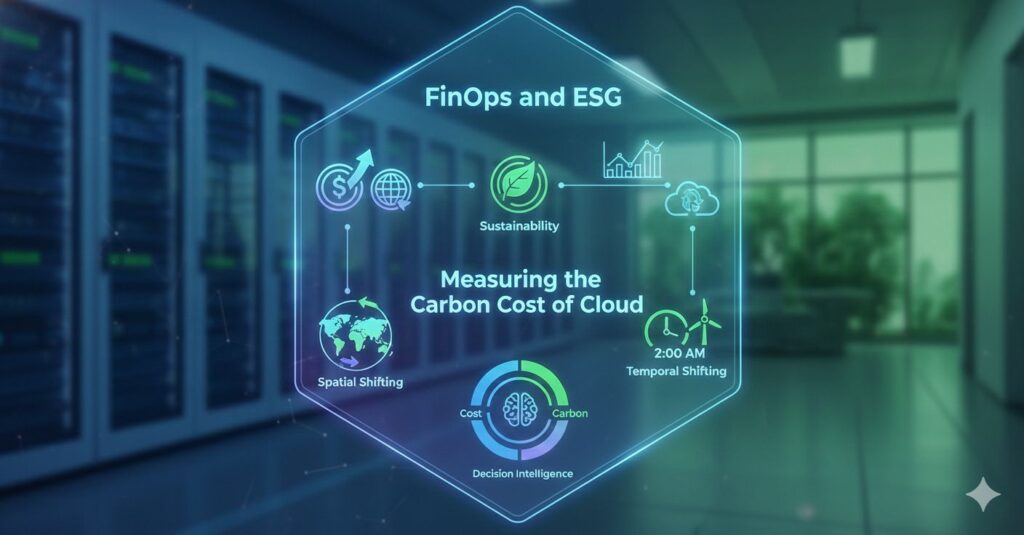
Carbon-Aware Computing in Action FinOps isn’t just about deleting things; it’s about making smarter choices. Modern practitioners are now practicing Carbon-Aware Computing, which involves two key strategic shifts:
- Spatial Shifting (Where you run): Choosing regions powered by renewable energy (like 90%+ clean grids) over coal-heavy alternatives.
- Temporal Shifting (When you run): Moving non-urgent batch jobs to 2:00 AM when wind power peaks and the grid is less stressed.
A Real-World Scenario: A retail analytics team shifted their nightly processing to a renewable-heavy region and off-peak hours. The result? Zero impact on delivery, marginal cost change, but a double-digit reduction in carbon emissions. This is the “Smart Trade-off” in action.
The Transparency Bridge ESG reporting used to be a yearly “feel-good” PDF. Now, regulations like the CSRD are forcing companies to prove, not promise, their sustainability.
This is where the FinOps practitioner becomes a strategic hero. We already have the data pipelines to track spend. By adding a “Carbon Lens” to our showback reports, we change behaviour faster than any corporate mandate. FinOps taught us how to explain cost to engineers; now it helps us explain carbon to the board.
The Green Paradox Lesson from the Field: The cheapest cloud isn’t always the cleanest. An older, less efficient data centre might be cheaper, while a brand-new sustainable facility carries a premium.
This is where FinOps evolves into Decision Intelligence. It’s about understanding the second-order impact of every decision not just cost, but carbon, compliance, and brand trust. The goal isn’t necessarily the lowest bill; it’s the smartest trade-off.
The Future-Facing Call to Action The wall between finance and sustainability is crumbling. Whether you call it FinOps, GreenOps, or simply good engineering, the principle is the same: eliminate waste, create value, and measure what matters.
As organisations move toward net-zero, managing the carbon cost of cloud will become as routine as managing the financial cost. The teams ready for this shift won’t start from scratch they’ll be the ones who already mastered the art of FinOps.
In the next era of cloud, the best engineers won’t just ship fast they’ll ship responsibly.
#FinOps #GreenOps #Sustainability #CloudFinance #ESG #CloudComputing #TechLeadership #NetZero #DecisionIntelligence