Most enterprise risk doesn’t start with a bang. It doesn’t begin in a high-stakes boardroom or during a multi-million-dollar strategy offsite.
It begins with a whisper.
It starts inside a sprint cycle, a deployment window, or a fleeting moment of technical urgency. A developer needs to solve a problem now. So, they make a choice.
- A configuration is toggled.
- A third-party service is integrated.
- A dataset is replicated.
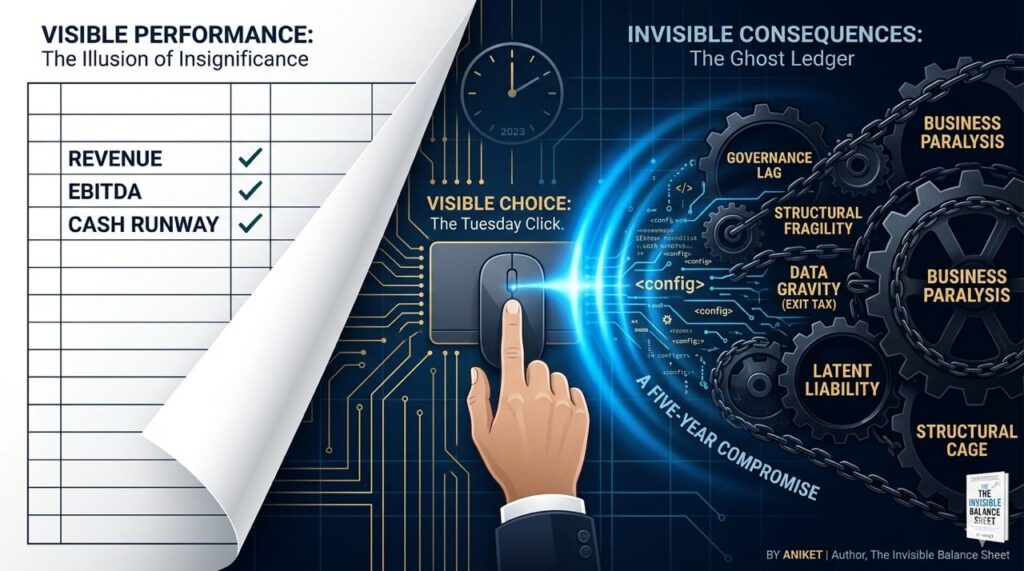
The decision takes less than sixty seconds. It happens on a Tuesday afternoon and because it feels small, no one ever thinks about it again.
The Illusion of Insignificance
In the Age of Iron, meaningful decisions were visible. You built a factory. You hired a hundred people. You signed a twenty-year lease. Capital moved slowly, and risk had a physical shape. It was easy to identifybecause you could see it on a map or a manifest.
But we now live in the Age of Ether.
Today, capital moves through systems, code, and architecture. Because these decisions are fast and distributed, they are rarely treated as capital allocation events. But that is exactly what they are. Every “minor” technical choice is a financial commitment in disguise.
When a Click Becomes a Commitment
That thirty-second Tuesday decision doesn’t just solve a bug; it creates a trajectory. It might:
- Anchor your data to a specific vendor ecosystem you can’t leave.
- Introduce dependencies that are exponentially expensive to unwind.
- Create cost structures that compound silently over the next five years.
Individually, these clicks are invisible. Collectively, they become Structural Fragility. This is how modern enterprises accumulate what never appears on traditional financial statements: Invisible Liabilities.
Your P&L will eventually record the cost of that decision, but your balance sheet will remain unchanged. Neither will capture what was actually lost: Optionality.
The Birth of the Ghost Ledger
The danger isn’t the first Tuesday Click. It’s the accumulation of hundreds of them. This is the birth of the Ghost Ledger. Each click slightly reduces your flexibility. Each one slightly delays governance visibility. Nothing breaks immediately. There is no alert, no escalation, and no audit finding. But over time, the system becomes a cage. It becomes harder to change, slower to adapt, and ruinously expensive to operate.
When the market pivots or a breach occurs, the cost finally surfaces not as a line item, but as a paralysis of the business itself.
The Governance Shift: Preserving Movement
The problem in modern business isn’t speed. Speed is a requirement. The problem is unpriced speed.
Organisations need a new discipline. Governance in the digital age is not about control or slowing down; it is about preserving freedom of movement. To become what I call a Sovereign Enterprise, leadership must start asking three critical questions before the click happens:
- Strategic Optionality: Does this decision keep our doors open, or does it lock us into a room?
- Structural Fragility: If this vendor or service fails, do we cease to function?
- Latent Liability: Are we saving ten rupees today only to pay a thousand-rupee bill tomorrow?
The Personal Ledger
This principle applies to your career just as much as your company. Your own “Tuesday Clicks” happen every day:
- The shortcut you take in a project report.
- The difficult conversation you avoid because it feels “uncomfortable.”
- The skill you choose not to build because the current tool is “good enough.”
Each one feels insignificant. Each one compounds. Over time, these choices determine your Trust Equityand your ultimate ability to lead.
The Question That Matters
In the digital economy, the smallest actions carry the largest consequences. The next time a decision feels “small,” stop and look beneath the surface.
Ask yourself: What is this decision quietly committing me to? Because the Ghost Ledger always collects its due.