The Hidden Psychology Behind Customer Behaviour, Employee Adoption, and Digital Transformation
A customer walks into a store.
You show them two bottles of wine.
The first costs ₹800. The second costs ₹3,500.
They taste both, pause thoughtfully, swirl the glass, and confidently explain why the ₹3,500 bottle is clearly superior.
It has a richer finish. Better balance. More character.
Now, imagine the twist. Both glasses were poured from the exact same bottle.
Suddenly, the conversation becomes uncomfortable.
Because most of us like to believe we are rational. We believe our decisions are driven by logic, evidence, and objective evaluation. Yet human behaviour tells a completely different story.
Sometimes we do not buy the better product. We buy the better story.
Sometimes we do not choose the highest quality option. We choose the option that feels like the highest quality option.
This simple psychological bias creates one of the most expensive mistakes businesses make: Organisations listen to what people say. Successful organisations observe what people do.
The difference between those two approaches can be worth millions.
The Camera Effect
Ask someone how they would behave, and you often get a very different answer from how they actually behave.
Put a person in front of a survey, a focus group, a town hall, or a performance review, and something fascinating happens: They become the “Camera Version” of themselves.
Under observation, people become:
- More disciplined
- More organised
- More health-conscious
- More financially responsible
- More compliant
- More rational
In short, they become the person they aspire to be, rather than the person they consistently are.
Then reality arrives.
The same customer who says they carefully compare prices buys the premium option because it feels more trustworthy. The same customer who claims they make objective decisions chooses the product with the better packaging.
And the same employee who enthusiastically supports a new process finds a shortcut around it the moment nobody is watching.
People are not lying, at least not intentionally. The truth is far more interesting: Most decisions happen below conscious awareness. We act first, and we rationalise later.
The Price Illusion
Behavioural economists have studied this phenomenon for decades. Raise the price of a product without changing anything else, and people will automatically perceive the product as better.
The famous medical placebo studies demonstrated this perfectly. Participants reported significantly greater pain relief from an identical placebo pill simply because they were told it was more expensive. The price changed the biological experience, not the product.
Think about luxury watches. Most entry-level smartphones tell time more accurately than a mechanical luxury watch costing several lakh rupees. Yet people continue buying luxury watches.
Why? Because they are not purchasing accuracy. They are purchasing:
- Identity
- Status
- Achievement
- Meaning
If companies only listened to customer interviews, they might conclude: “Customers want accurate timekeeping.” By observing behaviour, they discover the real answer: “Customers want to communicate something about themselves.”
One insight builds better clocks. The other builds billion-dollar brands.
The Compliance Mirage
Unfortunately, organisations make this exact same mistake internally. They assume employees behave as rationally as customers claim to behave.
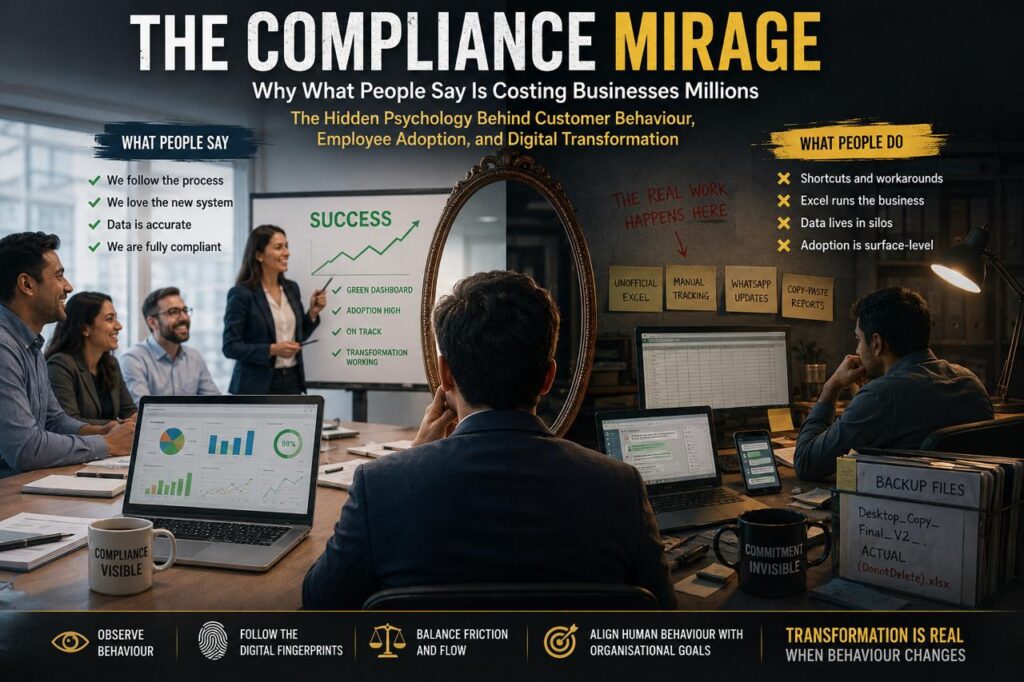
This creates what I call the Compliance Mirage: the dangerous illusion that agreement equals adoption.
People agree with the process.
- They attend the training.
- They acknowledge the policy.
- They complete the checklist.
- Yet their day-to-day behaviour remains unchanged.
The illusion that because a dashboard is green, a transformation is working. The illusion that because a policy exists, behaviour has changed.
- Compliance is visible.
- Commitment is not.
- Compliance fills reports.
- Commitment changes habits.
- Compliance appears in meeting minutes.
- Commitment appears when nobody is watching.
Most organisations measure compliance because it is easy. The problem is that compliance often creates the appearance of progress while hiding the absolute absence of change. And appearances can be incredibly expensive.
The Project Manager Paradox
Consider a common workplace scenario.
A project manager insists that every task must be meticulously documented. Every hour tracked. Every dependency recorded. Every status updated.
During sprint planning sessions and governance reviews, the team agrees completely. Documentation is important. Tracking matters. Visibility is critical. Everyone nods. Everyone complies at least on paper.
Then reality begins.
Jira tickets get filled with generic text copied and pasted from previous tasks. Time sheets are completed on Friday at 4:55 PM based on rough, backward-engineered estimates rather than actual work. Meanwhile, the real cross-functional collaboration happens through rapid WhatsApp messages, hallway conversations, and unofficial calls.
The dashboard shows perfect compliance. The behaviour tells a completely different story.
The organisation believes it has visibility. In reality, it has theatre.
Transformation Theatre
This is where many multi-crore digital transformation initiatives quietly go to die.
Welcome to Transformation Theatre.
The presentations are transformed. The governance structure is transformed. The reporting dashboards are transformed. The terminology is transformed.
The behaviour is not.
Employees say they support the new platform. Managers report successful adoption. Leadership celebrates milestone completion. The project status turns a beautiful, reassuring shade of green.
Then, six months later, somebody discovers a file hidden on a local drive:
Desktop_Copy_Final_V2_ACTUAL(DonotDelete).xlsx
It is still running. It is still critical. It is still far more trusted than the multi-crore enterprise platform designed to replace it.
The technology changed. The behaviour did not and behaviour always wins.
Why Smart People Create Workarounds
Many leaders assume workarounds exist because employees are stubborn or resist change. Most of the time, the opposite is true. People create workarounds because they are desperately trying to get their work done.
- Human beings are wired to naturally minimise friction.
- If a new corporate process requires six additional clicks, they will look for a shortcut.
- If a platform is slower than Excel, they will return to Excel.
- If documentation takes longer than execution, they will document just enough to satisfy the system.
This is not sabotage; it is optimisation. People are constantly optimising for effort, speed, convenience, and real-world outcomes.
The Micro-Optimisation Trap: Why Letting Shortcuts Slide Destroys the Macro Vision
However, there is a critical trap here. Just because we understand why people create shortcuts does not mean leaders should simply allow them to happen.
If you just listen to the complaints and let teams bypass steps, the entire organisational exercise will eventually collapse.
Why? Frontline teams naturally optimise for local outcomes. Leadership teams must optimise for system outcomes. Both perspectives are valid. The challenge is that what improves one part of the system can unintentionally damage another.
To an individual sales rep or engineer, entering detailed data into a system feels like useless administrative friction. They bypass it to save five minutes. But look at the cross-functional domino effect:
Missed Critical Milestones: A skipped step means a dependency is unfulfilled, stalling a project down the line.
Cross-Functional Blindness: The product, finance, or compliance teams are left completely in the dark because the information they rely on was never logged.
The Loss of the Larger View: When everyone creates their own customized shortcuts, leadership loses the single source of truth required to make high-stakes, strategic business decisions.
While a single team might celebrate a “faster workflow,” the business as a whole is quietly suffering from data decay. The question leaders should ask is not just: “Why aren’t people following the process?”
The hidden cost is rarely visible to the individual creating the shortcut. The real impact often appears later in the form of rework, missed dependencies, reporting gaps, and delayed decisions.
The deeper question is: “How do we balance removing user friction without sacrificing critical cross-functional governance?”
The Friction Paradox
Most transformation leaders make one of two mistakes. The first group eliminates every possible control in pursuit of speed. The second group adds layer upon layer of governance in pursuit of visibility.
Both eventually fail.
Too much friction creates workarounds. Too little friction creates chaos. The goal is not to eliminate friction. The goal is to place friction where it protects the business and remove friction where it slows the business.
Great organisations understand the difference.
What Great Organisations Measure
The biggest mistake a business can make is measuring what people report instead of what people repeatedly do. Behaviour leaves fingerprints; opinions leave stories. Both matter, but only one reveals reality.
Instead of asking your team or your customers, “Are you using the platform?”, you must measure the digital fingerprints:
- How often is it actually used outside of mandatory hours?
- Which features are actively adopted, and which are completely ignored?
- Where exactly do users abandon workflows or experience lag?
- How often is data being exported to Excel to finish the job?
- Where do tasks remain stuck in the pipeline?
- Every Organisation has Two Operating Systems
Every organisation runs on two operating systems.
The first is the Official Operating System.
It lives in governance frameworks, policies, process documents, project plans, and PowerPoint presentations.
The second is the Real Operating System.
It lives in shortcuts, workarounds, unwritten rules, Excel spreadsheets, WhatsApp groups, and hallway conversations.
Most leaders spend their careers managing the first. Exceptional leaders spend time understanding the second. Because businesses do not run on documented processes.
They run on human behaviour.
Final Thought
The greatest risk in digital transformation is not a loud resistance to change. It is the quiet, polite illusion that change has already happened.
Organisations spend fortunes collecting opinions, conducting surveys, running workshops, and building dashboards. Yet the most valuable insights are always hidden in the places nobody is looking: the abandoned shopping cart, the skipped workflow, the unofficial spreadsheet, and the process everybody says they follow but nobody actually uses.
Opinions tell you who people want you to think they are. Behaviour tells you who they actually are. But leadership is not about choosing one over the other.
It is about designing systems where the behaviour that feels easiest for individuals also creates value for the organisation. Because businesses do not scale through compliance.
They scale when human behaviour and organisational goals finally point in the same direction. That is when adoption becomes habit.
That is when transformation becomes real.