Why clarity, not conformity, shapes meaningful transformation. There is something strangely comforting about moving with the crowd. In business, agreement often feels like safety. If competitors are investing, consultants are endorsing, and headlines are celebrating the same trend, following along feels rational, even responsible.
But some of the costliest mistakes in modern organisations began exactly this way.
If everyone is adopting the same tool, chasing the same trend, or repeating the same strategy, it feels safe to follow. In boardrooms and leadership meetings, consensus often sounds like confidence. When competitors announce ambitious digital programs and headlines celebrate the newest technology wave, moving in the same direction feels rational, even responsible.
But history tells a different story.
Some of the most expensive business failures did not happen because organisations lacked intelligence, talent, or resources. They happened because people stopped questioning the noise around them. They mistook momentum for wisdom and popularity for proof.
Nowhere is this more dangerous than in digital transformation.
Today, transformation has become a word that travels faster than understanding. Artificial intelligence, automation, cloud migration, analytics, low-code platforms, digital experience redesign organisations rush to adopt them, often driven less by strategy and more by the quiet fear of being left behind.
This is the bandwagon effect at work and it can be incredibly costly.
True transformation is not a race for approval. It is an exercise in judgment. It demands something that rarely trends on social media or appears in marketing brochures: clarity.
1. The Bandwagon Trap
Human beings are social creatures. We learn by observing others. We mirror behaviour, seek validation, and move toward what appears socially accepted. For most of human history, this instinct helped us survive. Belonging to the tribe meant safety.
But inside organisations, the same instinct can quietly weaken independent thinking.
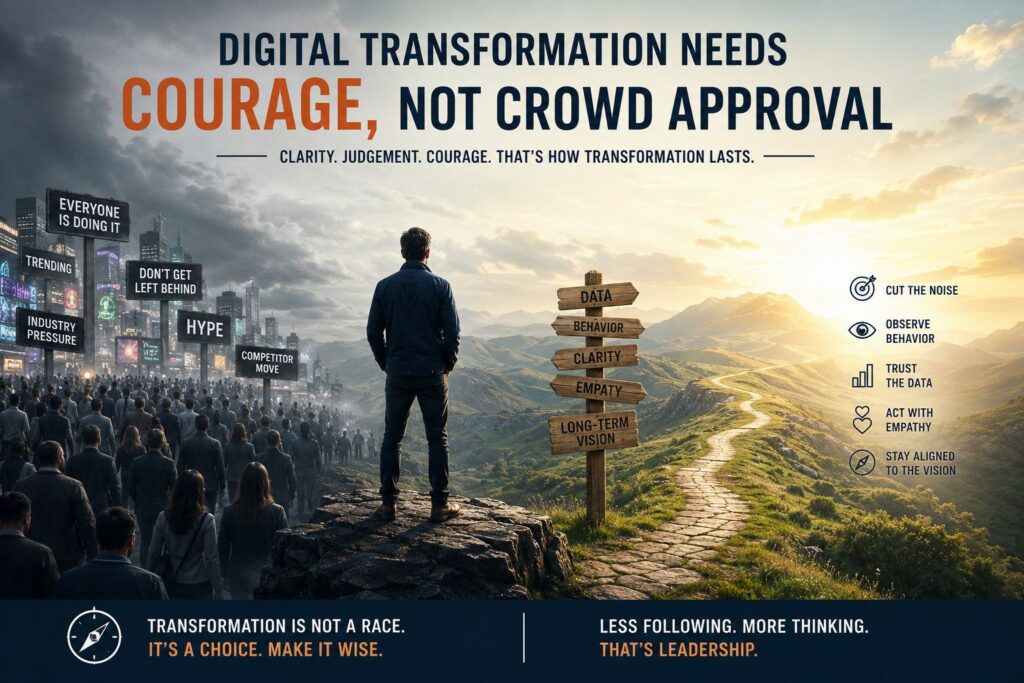
When a consultant declares, “Everyone is doing this,” resistance begins to feel outdated. When competitors announce sweeping technology investments, leadership teams feel pressure. When industry conferences celebrate the next digital revolution, hesitation starts to look like incompetence.
This creates a dangerous illusion that following the crowd is the safest option.
But transformation is not fashion. Technology does not create value simply because it is popular. A poorly timed or poorly understood transformation remains a poor decision, even if everyone else is making it.
The real question is rarely: “What are others doing?” It should be: “What problem are we trying to solve, and what does our evidence tell us?”
This shift in thinking matters because meaningful transformation requires something far more valuable than hype: clarity. Sometimes clarity means moving quickly. Sometimes it means waiting. And occasionally, it means making the deeply unpopular decision to stand still while everyone else runs.
That takes courage.
2. Activity Is Not Progress
One of the most dangerous illusions in digital transformation is the belief that movement equals momentum. Organisations often become busy before they become better.
- More meetings.
- More dashboards.
- More pilots.
- More vendors.
- More “transformation programs.”
Activity creates visibility. Progress creates value and the two, are not the same.
Many organisations unknowingly reward motion because motion feels productive. A packed transformation roadmap looks impressive. A growing technology portfolio creates the appearance of advancement. Frequent status meetings provide reassurance that something is happening.
Motion Can Look Like Progress
Deploying a new platform — with zero adoption
Building expensive dashboards — without changing decisions
Migrating to the cloud — without improving how work gets done
Expanding transformation teams — while culture remains unchanged
This is where leadership discipline matters. Real transformation is often quieter than expected. It appears in capability, in decision quality, in culture, and in customer outcomes. It shows up in how people work differently, not merely in what systems they use.
The question is not whether your organisation is busy. It is whether it is becoming better?
3. Data Must Speak Louder Than Narrative
Modern organisations are drowning in information and starving for insight. Dashboards multiply. Reports expand. Opinions grow louder and narratives spread faster than evidence.
Transformation discussions often become dominated by stories industry excitement, market fear, competitive urgency, vendor promises, and internal assumptions. These narratives can be persuasive because they offer certainty in uncertain environments.
But persuasive does not always mean true.
Narratives are contagious. Facts are disciplined and often, the two do not agree.
The challenge for leaders is learning to separate signal from noise. Not every trending conversation deserves investment. Not every internal excitement deserves funding. Not every fear deserves a response.
Strong transformation decisions emerge when leaders resist the temptation to confuse emotional momentum with strategic necessity. This does not mean ignoring people or dismissing intuition; it means refusing to let assumptions replace reality.
Evidence matters because long-term vision is fragile. Once organisations begin reacting to every external narrative, strategy becomes unstable and direction becomes reactive. Leadership, at its core, is the discipline to ask difficult questions when everyone else appears certain:
- What does the data actually say?
- What assumptions are we carrying?
- What specific problem are we solving?
Clarity is rarely loud. It is usually deliberate, and sometimes uncomfortable.
4. Stop Listening. Start Observing.
This idea may sound counterintuitive. After all, organisations proudly describe themselves as customer-centric and stakeholder-driven. Surveys, interviews, workshops, and feedback sessions have become central to modern decision-making.
Trust me, they do matter. But there is a deeper truth that leaders often overlook: People do not always behave the way they describe themselves.
Psychology calls this the gap between stated preference and revealed behaviour.
- Customers may say they want simplicity while repeatedly choosing complex, feature-heavy premium experiences.
- Employees may verbally support change while continuing to rely on familiar, legacy manual processes.
- Stakeholders may advocate for innovation but reward short-term safety the moment uncertainty appears.
Words reveal intention. Behaviour reveals reality.
If organisations build solely around what people say, they risk designing for aspiration instead of behaviour and aspiration can be misleading.
Digital transformation succeeds not by reacting to declarations alone, but by studying patterns.
- Look at adoption rates.
- Look at abandonment.
- Look at system usage.
- Look at friction points.
- Look at where people spend time, attention, and money.
Behaviour predicts the future more accurately than opinion. You can say anything, but what people repeatedly do is usually what happens next. The most mature organisations do not merely collect feedback, they observe behaviour and design around reality.
5. Speed Is Valuable. Haste Is Expensive.
Modern business celebrates speed. Move fast. Decide quickly. Act now. There is undeniable wisdom in urgency. Markets evolve rapidly, technology changes constantly, and delayed decisions carry genuine risk. But speed and haste are not the same thing.
A rushed decision is often a partial decision. It may solve the visible problem while ignoring second-order consequences. It may deliver short-term relief while quietly creating long-term complexity, technical debt, or cultural resistance.
Leadership is not slow indecision. Nor is it reckless acceleration. It is the ability to reach the best possible decision in the quickest responsible timeframe.
Good decisions require three anchors:
Logic — to challenge assumptions and ensure structural soundness.
Data — to validate reality and ground choices in evidence.
Emotional Empathy — to understand the human impact of change.
Remove any one of these anchors and decisions become fragile. Pure logic may ignore people. Pure empathy may ignore feasibility. Pure data may ignore context and artificial urgency creates regret.
This does not mean embracing endless analysis. Analysis paralysis is simply fear disguised as caution. Decisions need boundaries, and deadlines matter. But wisdom lies in balancing urgency with depth. The goal is not perfection; it is disciplined clarity.
6. The Human Problem Behind Digital Transformation
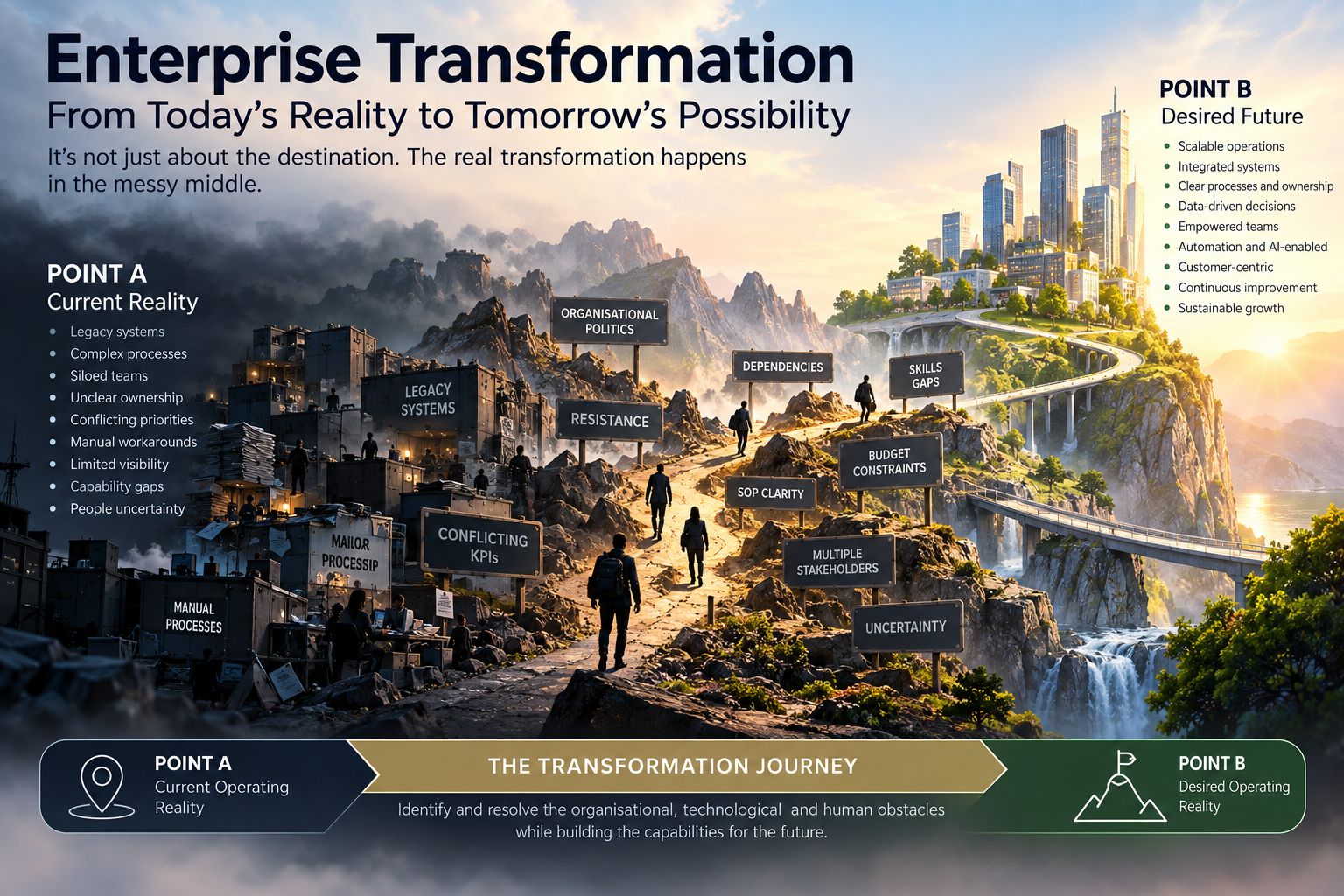
Perhaps the greatest misconception about digital transformation is that it is primarily a technology problem. It is not. It is a human one.
Technology changes quickly. Human behaviour changes slowly.
The pressure to conform, to adopt what others adopt and believe what others believe, will always exist. Not because people are irrational, but because people are social. We absorb narratives from peers, markets, consultants, and industries until those narratives begin to feel like truth.
This is why leadership courage matters. Long-term thinking begins where social comfort ends.
Sometimes protecting the future requires disappointing the present. A transformation initiative may need to pause despite industry excitement. A heavily marketed technology may deserve rejection despite competitive pressure. A leadership team may need to defend an unpopular path because the evidence points there.
This can feel isolating. But the right decision is not always the popular one.
The leaders who shape meaningful transformation are not immune to pressure; they simply refuse to let pressure become strategy. They understand that trends change, narratives evolve, and markets fluctuate. But vision anchored in evidence and purpose creates resilience.
Write strategy in stone. Write execution in pencil. Let tools evolve, but let direction remain intentional.
7. Transformation Is Judgment, Not Technology
Digital transformation is often presented as a technology story. It is not. It is a judgment story. It is about knowing:
- When to adopt and when to resist.
- When to accelerate and when to pause.
- When to listen and when to observe.
- When to choose evidence over applause and clarity over conformity.
The organisations that thrive in the coming decade will not necessarily be the ones moving with the loudest crowd. They will be the ones thinking with the clearest minds.
Transformation is not won by chasing every signal. It is won by knowing which signals deserve your attention, and having the courage to ignore the rest. When everyone is rushing toward certainty, leadership is the courage to pause, observe, and choose with clarity.
A Practical Tool: The C.L.E.A.R. Framework
Before approving any major transformation initiative, leaders can pause and ask five simple questions:
C – Cut the Noise: Are we reacting to hype, competitor pressure, or vendor narratives?
L – Look at Behaviour: What are customers, employees, and stakeholders actually doing, rather than saying?
E – Evaluate Data: Does the empirical evidence support this decision over the long haul?
A – Act with Empathy: How will this change affect real people, our culture, and daily workflows?
R – Remain Aligned: Does this move strengthen our long-term vision or merely satisfy short-term anxiety?
Frameworks do not replace judgment, but they can protect it and in an era overflowing with noise, protection of judgment may be leadership’s most important responsibility.
Digital transformation is often presented as a technology story.
It is not. It is a judgement story. It is about knowing:
- When to adopt and when to resist.
- When to accelerate and when to pause.
- When to listen and when to observe.
- When to follow evidence instead of applause.
The organisations that thrive in the coming decade will not necessarily be the ones moving with the loudest crowd or chasing every new signal.
They will be the ones thinking with the clearest minds. Because transformation is not won by chasing every possibility. It is won by knowing which signals deserve your attention and having the courage to ignore the rest.
Technology will continue to evolve. Trends will rise and fade. Narratives will change. But clarity, discipline, and human judgement remain timeless and perhaps that is the quiet truth beneath every successful transformation.
Progress does not belong to those who follow the crowd. It belongs to those who understand where they are going and why.