The Transformation Synchronisation Framework: Why people, systems and communication must move together
We often talk about digital transformation through the language of technology.
Cloud. AI. Data. Automation. Platforms. Modernisation.
But technology is rarely the hardest part of transformation.
The harder question is:
Can an organisation get its people and its systems to change at the same time, in the same direction, for the same purpose?
Because transformation is ultimately about two things: people and systems.
Systems need to change because the organisation wants to operate differently. People need to change because new systems, processes and expectations require different ways of working.
Sometimes the relationship works in reverse. People change first. They develop new capabilities, adopt new behaviours and discover better ways of working. The underlying systems then need to evolve to support them.
The most successful transformations happen when both move together, but what keeps them moving in the same direction?
Communication.
Not communication as another email from leadership. Not communication as a town hall announcing what has already been decided.
Communication is the mechanism that keeps people, systems, strategy and business outcomes moving together.
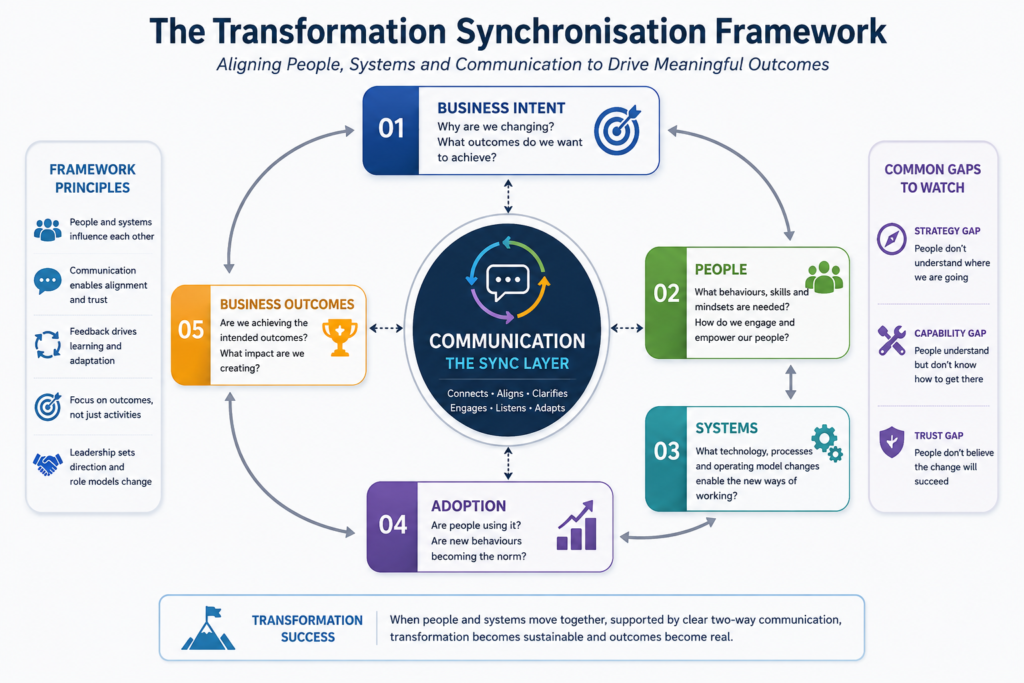
This is the thinking behind my Transformation Synchronisation Framework.
At its core:
Business Intent → People ↔ Systems → Adoption → Business Outcomes
And running through all of it:
Communication — the Sync Layer.
Start With the Business, Not the Technology
Every transformation should begin with a business problem or ambition.
- We don’t really need AI because we need AI.
- We need AI because we may want to improve customer experience, accelerate decision-making, reduce operational effort or create new capabilities.
- We don’t need cloud simply because cloud is modern.
- We may need it because the organisation needs greater agility, resilience or scalability.
Technology is the enabler. The business outcome is the destination.
This sounds obvious, but it is where many transformation conversations become disconnected. If people cannot explain why the organisation is changing, every subsequent technology decision becomes harder to understand.
People know something is happening, but they don’t understand why. That is the first gap: the strategy gap and that is where communication begins.
People and Systems Have to Move Together
Consider what happens when an organisation introduces a new enterprise platform.
The technology changes, but suddenly people have to learn new processes, develop new skills, collaborate differently, make different decisions and leave behind familiar workarounds.
The system has changed.
But has the organisation transformed? Not necessarily. The opposite can happen too.
People may become more data-driven. They may start using AI. They may develop new capabilities and discover better ways to serve customers, but if the underlying systems, policies and processes prevent them from working differently, the organisation eventually pulls them back towards the old way of operating.
That is why I don’t see transformation as:
Technology → People
I see it as:
People ↔ Systems
Each influences the other.
The system must enable the behaviour. People must adopt the system. Processes must reinforce both. Leadership must create the conditions for the change to stick.
This is also consistent with established change-management thinking: technical implementation and human adoption are inseparable if an organisation is to realise the intended value of change. (prosci)
This Is Where Communication Becomes Different
Communication is often treated as:
“Let’s tell everyone what is happening.” But transformation communication has a much bigger job. It connects strategy with execution. Leadership with employees. Technology with behaviour. Decisions with consequences. Today’s reality with tomorrow’s ambition.
Without that connection, different parts of the organisation start moving at different speeds.
Leadership believes the organisation is moving forward. Technology teams believe the solution is ready. Employees believe they are still waiting for clarity. Managers struggle to explain what the change actually means. Customers may experience the disruption before they experience the benefit.
Suddenly, the transformation has multiple realities.
The technology roadmap says one thing. The employee experience says another. The leadership narrative says something else. Communication brings those realities into the same conversation and this is why I believe communication should not sit at the end of a transformation plan under a heading called “Communications”.
It belongs at the centre.
The Higher You Go, the Larger the Blast Radius
There is another reason communication becomes increasingly important as we move up the leadership ladder.
Early in our careers, our decisions tend to have a relatively contained impact.
We ask:
What does this decision mean for my work?
Then our responsibilities grow.
What does this decision mean for my team?
Then:
What does this decision mean for my function?
Eventually:
What does this decision mean for the organisation?
At enterprise leadership level, the answer can extend much further.
A single decision can affect employees, teams, functions, customers, suppliers, partners, regulators, shareholders and ultimately the brand.
The higher we move into an organisation, the larger the blast radius of our decisions.
That changes the role of communication.
A senior leader cannot simply say:
“This is the decision.”
They need to explain why the decision was made, why now, what problem it solves, what changes, what doesn’t change, who is affected and what success will look like and perhaps the most important question:
What does this mean for me?
Authority Can Create Compliance. Communication Creates Understanding.
Hierarchy has not disappeared. Decision rights matter. Accountability matters. Leaders still need to make difficult decisions, but hierarchy alone does not create commitment.
A leader can say:
“This is what we are doing.”
That can create compliance, but compliance is not the same as ownership. People need context. They need to understand the destination and their role in getting there. They also need to believe that leadership is prepared to listen and adapt. That doesn’t mean everyone needs to agree with every decision. It means people need enough clarity, context and trust to participate meaningfully in the change, and that requires communication to flow both ways.
Traditional organisational communication often looks like:
Leadership → Message → Organisation
Transformation needs something closer to:
Leadership → Direction → Organisation → Feedback → Learning → Adaptation
The organisation needs to hear from leadership, but leadership also needs to hear from the organisation.
Communication therefore has two jobs:
Explain the change.
And:
Sense the organisation.
If communication only travels downward, transformation becomes an instruction.
If it travels in both directions, transformation becomes a conversation.
The Three Gaps
When I think about transformation through this lens, I see three gaps that can quietly derail it.
- The first is the strategy gap.
- People don’t understand where the organisation is going or why.
- The second is the capability gap.
- People understand the destination but don’t have the skills, tools or support to get there.
- The third is the trust gap.
- People understand the change and may even know what to do, but they don’t believe the transformation will succeed.
Communication influences all three, but communication cannot solve all three by itself.
- A poor strategy cannot be fixed with better messaging.
- A broken system cannot be fixed with a town hall.
- A capability gap cannot be fixed with an email.
- A trust gap cannot be fixed with corporate slogans.
Communication connects the elements. It does not replace them.
So, How Do We Know Transformation Is Actually Happening?
Perhaps we are asking the wrong question.
We often ask:
“Did we implement the technology?”
A better question is:
“What are people doing differently today that they were not doing before?”
Are decisions being made differently?
Are customers experiencing something different?
Are teams collaborating differently?
Are processes simpler?
Are people spending less time on low-value work?
Are new capabilities actually being used?
Are leaders measuring different outcomes?
Are the systems enabling the behaviours the organisation needs?
If the answer is yes, transformation is happening.
If the only answer is:
“We went live last quarter.”
Then perhaps we implemented technology. We may not have transformed.
The Transformation Conversation
Ultimately, I believe the organisations that transform successfully will not necessarily be those that deploy technology the fastest.
They will be those that can align people, processes, technology and leadership around a common business outcome.
That is the thinking behind the Transformation Synchronisation Framework:
Business Intent → People ↔ Systems → Adoption → Business Outcomes
With Communication as the Sync Layer running through it all, because transformation is not a single event. It is a continuous conversation between leadership and employees, people and technology, strategy and execution, today’s reality and tomorrow’s ambition.
The best transformation leaders therefore aren’t simply the people who understand technology.
They are the people who can translate technology into business outcomes, business outcomes into organisational priorities, organisational priorities into behaviours, and behaviours into action.
And they can keep listening while they do it.
Because ultimately:
- Technology enables the change.
- People make the change real.
- Communication keeps them moving together.
And that is why I believe:
Transformation is not an implementation. It is a conversation that turns strategy into collective action.