One of the strangest things about project management is that a large part of the job is dealing with problems that don’t exist.
At least, not yet.
A Project Manager often worries about:
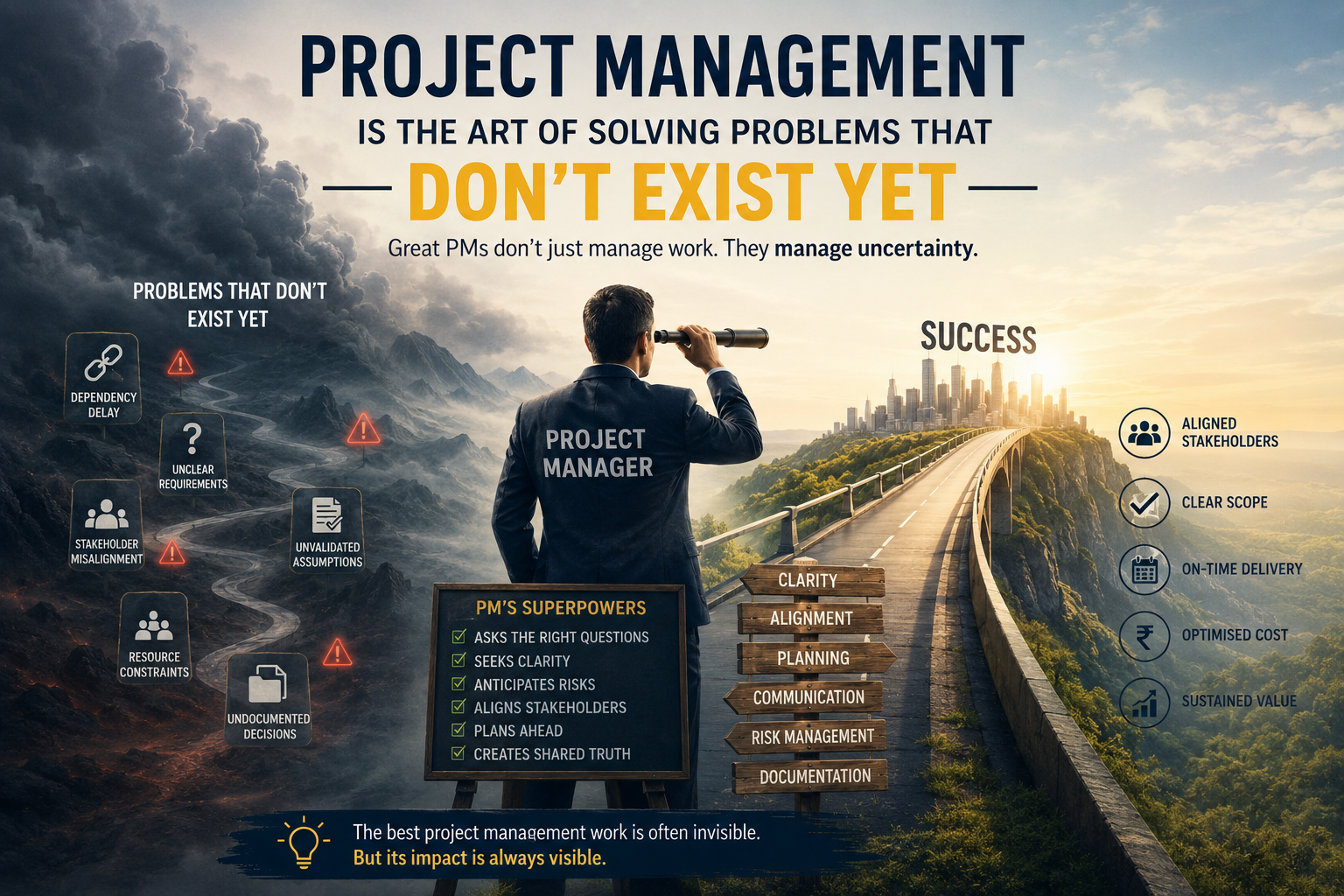
- A dependency that may get delayed.
- A requirement that isn’t completely clear.
- An assumption nobody has formally validated.
- A stakeholder who may interpret the scope differently.
- A resource constraint that could become a problem three months later.
- A decision that hasn’t been documented.
And naturally, someone eventually asks:
“Why are we discussing this? Everything is going fine.”
Exactly.
That is often the point.
Project management, in many ways, is the ability to look into the future and identify the problems that have not yet happened.
Not because a Project Manager is pessimistic.
But because fixing a small problem before it happens is significantly easier than fixing a large problem after it has already affected the project. When things are not clear, a Project Manager keeps asking. There is always something in a project that is not completely clear.
A requirement may have multiple interpretations. Ownership may be assumed but not explicitly assigned. A dependency may exist without anyone formally acknowledging it. The easy thing is to move forward and hope things become clearer along the way.
A good Project Manager rarely does that. They keep asking questions. They push for clarity. Sometimes, perhaps, more than people would like. Because when everything is going smoothly, nobody questions the ambiguity. But when something goes wrong, that same ambiguity suddenly becomes very important.
And by then, correcting it may require:
- Additional time.
- More resources.
- Scope changes.
- Budget increases.
- Rework.
- Escalations.
- Difficult stakeholder conversations.
A five-minute clarification at the beginning can sometimes prevent five weeks of correction later. That is why Project Managers worry about things that others may consider insignificant. They understand the cost of discovering an issue too late.
Documentation is not administration. It is alignment. Read this again slowly
Documentation, is not, administration. It is alignment.
Let’s be honest.
Nobody wakes up excited to write Minutes of Meetings.
Documenting decisions, sending meeting notes, maintaining action trackers and formalising communication is not the glamorous part of project management.
But it is one of the most important parts.
In a project with multiple stakeholders, teams and workstreams, people can attend the same meeting and walk away with completely different understandings.
- One person thinks something is approved.
- Another believes it is still under discussion.
- One team believes something is included in scope.
- Another assumes it is not.
- And everyone may genuinely believe they are correct.
This is where formal communication becomes important.
Documentation is not about creating paperwork. It is about creating a shared version of reality. A good meeting summary does something incredibly valuable: It gets everyone to agree on the same truth.
- What was decided?
- What was not decided?
- Who owns what?
- What are the dependencies?
- What are the timelines?
- What are the open questions?
Because projects rarely fail due to a lack of conversations. They often fail because everyone remembers the conversation differently. Smooth projects rarely get attention. The one that fails gets all of it.
Imagine managing ten projects.
Nine are progressing well. One begins to experience issues. Which project will consume most of the leadership attention?
The one that is struggling.
And here’s the interesting part. That one project can eventually impact the other nine. A delayed dependency can affect shared resources. A budget overrun can impact funding. A critical production issue can shift leadership focus. A major escalation can consume teams that were previously working on successful initiatives.
This is why project management cannot simply be about celebrating projects that are green.
A Project Manager needs to constantly look for the one potential issue that could create a ripple effect across the entire portfolio. Because in complex organisations, projects rarely fail in isolation. One problem often creates consequences elsewhere. Planning ahead is non-negotiable Planning is sometimes misunderstood as predicting the future.
It isn’t.
No Project Manager can predict everything. The purpose of planning is not to create a perfect future. It is to ensure you are not completely unprepared when the future changes. A good Project Manager usually has a broader view of the moving parts:
- Dependencies.
- Resources.
- Stakeholders.
- Risks.
- Timelines.
- Assumptions.
- Decisions.
- External factors.
This visibility allows them to see potential collisions before they happen.
Planning ahead is not bureaucracy. It is giving yourself enough time to respond intelligently instead of reacting desperately. There is a significant difference between the two.
A Project Manager manages assumptions as much as tasks
Most project problems don’t begin with a major failure. They begin with a small assumption.
- “I thought they were doing it.”
- “I assumed that was included.”
- “I thought we already had approval.”
- “I didn’t realise my work was dependent on yours.”
These sentences usually appear after the problem has already happened. This is why managing assumptions is one of the most underrated aspects of project management. Tasks are visible. Assumptions are not. Invisible assumptions can become visible problems very quickly. A good Project Manager brings assumptions into the open before they quietly turn into risks.
Risk Management Often Looks Like Pessimism
There is an interesting paradox in project management. The better you are at managing risks, the less visible your work becomes. If you identify a dependency early and resolve it, nobody sees the crisis that could have happened. If you clarify a requirement before development begins, nobody sees the rework that was avoided. If you escalate a resource issue early enough, nobody sees the delay that never happened.
And sometimes people may even wonder:
“Was all that concern necessary?”
Perhaps that is the paradox of good project management. When it works well, people often don’t see what was prevented. The Best Project Management work is fften invisible. We celebrate projects that are delivered. We celebrate milestones achieved. We celebrate successful launches.
But we rarely celebrate:
The risk that never materialised. The conflict prevented through early alignment. The scope ambiguity clarified before development started. The dependency identified before it caused a delay. The escalation that prevented a crisis. The difficult question that someone asked at exactly the right time. Yet these are often the moments where project management creates the most value.
Perhaps project management is not just about managing timelines, trackers and status reports. Perhaps it is something more fundamental.
It is the discipline of creating clarity before confusion, alignment before conflict and solutions before problems become visible.
Because by the time everyone can see the problem, it is often already expensive to solve. Perhaps that is the real job of a Project Manager.
To worry about tomorrow’s problems today, so that everyone else can focus on today’s work.