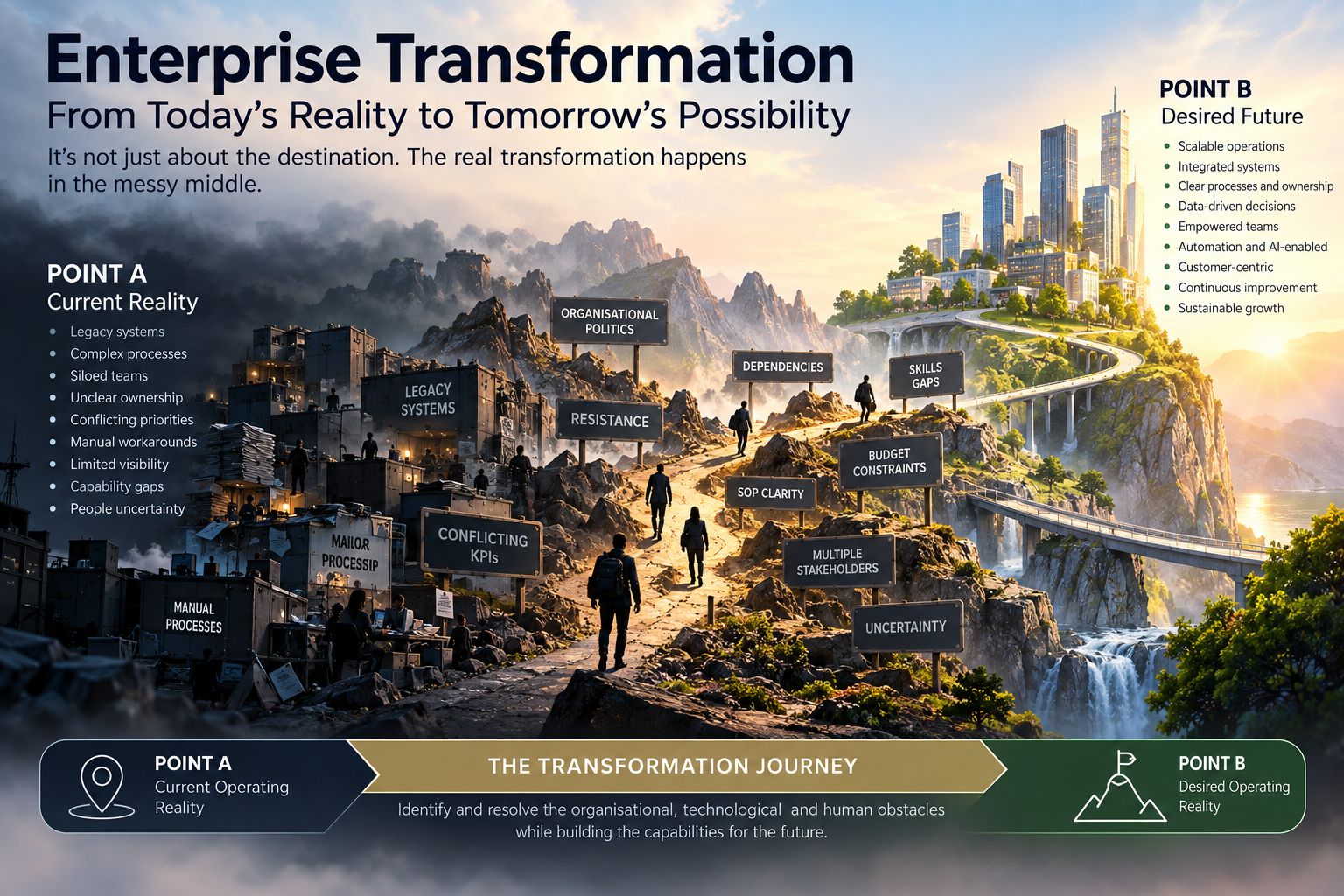
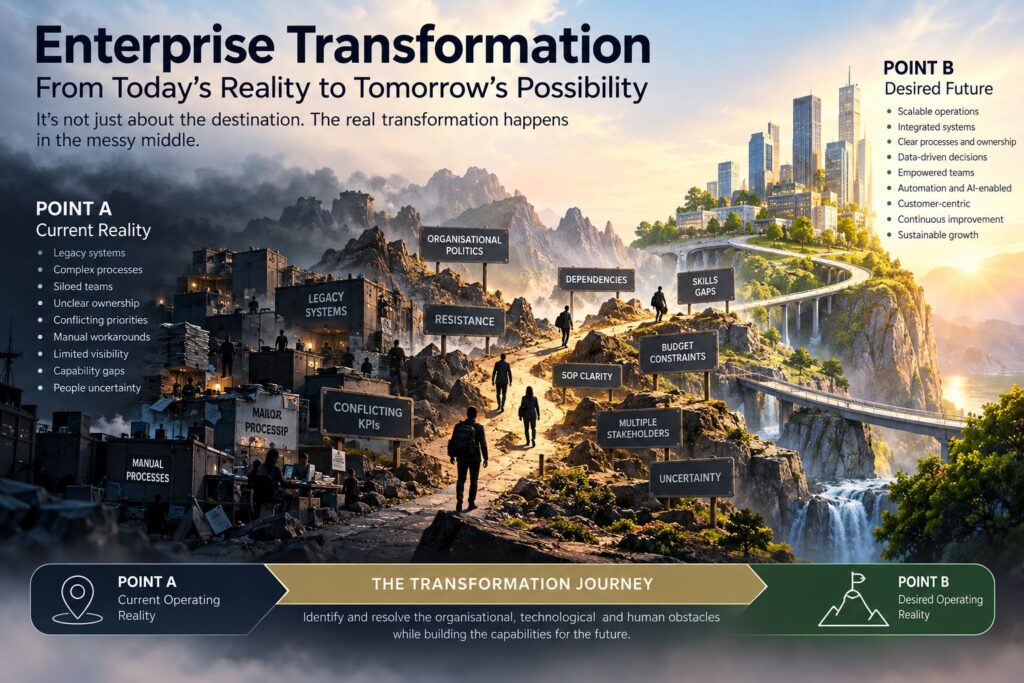
Enterprise transformation is often described by its destination. The real transformation happens in the difficult space between where the organisation is and where it wants to be.
Organisations rarely suffer from a shortage of transformation initiatives. There are digital transformation programmes, AI initiatives, ERP implementations, operating model redesigns, automation programmes, customer experience transformations and organisational restructuring exercises.
There are roadmaps. There are steering committees. There are consultants, project teams, workshops, dashboards and presentations and yet, somewhere inside the same organisation, a team may have been struggling with the same fundamental problem for three years.
Not because nobody knows the problem exists. Not because it is impossible to solve. Sometimes it simply isn’t large enough, visible enough, financially significant enough or represented strongly enough to command organisational attention.
That contradiction tells us something important. Perhaps we need to reconsider what we actually mean when we use the word transformation. Transformation is not the destination Most transformation programmes begin with a future state.
We want to become more digital.
We want to become AI-enabled.
We want a better customer experience.
We want to automate operations.
We want to introduce a new operating model.
We want to become more efficient.
We want…
In other words, leadership establishes a destination. If the organisation is currently at Point A, leadership wants it to reach Point B. On a transformation roadmap, this can look deceptively simple:
Point A → Point B
But organisations do not operate inside PowerPoint slides.
Between A and B sit legacy systems, unclear ownership, conflicting KPIs, undocumented processes, capability gaps, customer commitments, organisational politics, budget limitations, dependencies, competing priorities and people who have spent years learning how to operate within the existing system.
The real transformation therefore looks considerably more like:
Point A → obstacles → decisions → resistance → learning → failures → adjustments → capability building → Point B
That space between A and B is not something surrounding the transformation. That space is the transformation. Start with context, not the solution One of the easiest ways to weaken a transformation is to begin with:
“We need to implement this.”
Implement what?
And more importantly:
Why?
There is a significant difference between saying:
“We need to implement AI.”
and:
“Our current operating model cannot scale because too much organisational knowledge is trapped in individuals, decisions take too long and repetitive work consumes capacity that should be spent solving higher-value problems. We need to redesign how this work happens.”
AI might eventually be part of the solution. But now the organisation understands the problem. Without that context, transformation quickly becomes implementation. The organisation begins measuring whether the technology was deployed instead of whether the underlying organisational problem was resolved.
That distinction matters.
Transformation begins with context, not technology. Leadership vision must survive contact with operating reality. Senior leadership sees the enterprise from an important vantage point. But it is not the only vantage point. The people working inside processes every day see things that dashboards often cannot.
They know which approval theoretically takes one day but routinely takes seven. They know which system employees avoid. They know which spreadsheet quietly keeps an important process functioning. They know which SOP no longer represents how the work is actually performed. They know which customer problem keeps recurring. They know where teams have developed workarounds simply because fixing the underlying issue became too difficult.
The danger appears when information travels upward through several organisational layers and gradually becomes more comfortable.
Problems become exceptions. Risks become manageable. Complexities become bullet points and eventually management begins hearing not necessarily what the organisation needs it to hear, but what the organisation believes management wants to hear.
A transformation programme therefore needs something more valuable than reporting. It needs organisational truth.
Leaders need mechanisms through which uncomfortable operational reality can travel upward without being diluted along the way. Because you cannot transform an organisation you do not accurately understand. Are we resolving problems or circumventing them?
There is another question transformation teams should ask far more frequently:
Did we solve the problem, or did we simply find another way around it?
Workarounds are sometimes necessary. Organisations cannot stop operating every time they encounter a constraint. But temporary workarounds have an unfortunate tendency to become permanent operating models. A manual spreadsheet bridges a system limitation. Another approval compensates for unclear accountability. An additional person compensates for a broken process. Another meeting compensates for poor information flow. Another escalation compensates for missing decision authority. Individually, each workaround may be reasonable. Collectively, they can create an organisation that continues functioning while becoming progressively harder to change.
Transformation therefore requires the discipline to distinguish between circumventing a constraint and removing it. Sometimes the most valuable transformation work is not introducing something new. It is removing something that should no longer need to exist. Small problems can hide large opportunities organisational attention naturally gravitates toward large things.
Large customers. Large revenue opportunities. Large programmes. Large risks. Large budgets. Large executive priorities.
That makes sense.
Management attention is finite. But there is a dangerous assumption hidden inside this behaviour: that the current size of a problem represents the potential value of solving it.
It does not always.
A small team struggling with an operational constraint may receive little attention because the financial impact appears insignificant. Without attention, it receives little sponsorship. Without sponsorship, it receives limited resources and authority. Without those resources, the team struggles to demonstrate significant improvement and because the impact remains small, the initiative continues receiving little attention.
A vicious circle develops:
Low visibility → weak sponsorship → limited capability → limited impact → low visibility
The problem may never become important enough to solve because the organisation never creates the conditions necessary for it to become important. This is why transformation leaders must look beyond the immediate size of a problem.
A better question is:
What organisational capability could solving this problem unlock? Sometimes transformation begins with something surprisingly small. Transformation changes people too. Future-state diagrams usually show systems, processes, capabilities and organisational structures. But employees experience transformation very differently.
For them, the journey may look more like:
My current role → uncertainty → ?
What happens to my responsibilities? What skills will I need? Will decisions still sit with me? Will automation make my work easier or make my role unnecessary? Where do I fit into the organisation we are creating?
These questions become even more important as AI enters enterprise workflows.
We often describe employees as resistant to transformation without examining the uncertainty they are being asked to absorb. People cannot be given complete certainty during genuine transformation. If everything were already known, it would probably not be much of a transformation.
But ambiguity can be managed.
People need to understand what is known, what remains unknown, what is expected from them and how they can participate in building the future state. An organisation cannot transform while leaving its people permanently standing at Point A.
The devil really is in the details
Transformation strategy is often discussed at 30,000 feet. Execution happens at ground level and this creates one of the most persistent gaps in enterprise transformation.
Leadership may agree on the destination. Technology may be available. Budgets may be approved. The programme may even be officially launched. But eventually someone must answer questions such as:
Who owns this decision? Which process changes? Which system becomes the source of truth? Which KPI changes? Which team loses an existing responsibility? Which team gains one? Which legacy process stops? What happens when the new model conflicts with an existing customer commitment? Who can resolve that conflict?
These questions are less exciting than announcing a transformation strategy. They are also where transformation succeeds or fails. The devil is not merely in the details. The transformation is often in the details.
Transformation requires sponsorship not ceremonial sponsorship Most major programmes have an executive sponsor on a governance slide. That does not necessarily mean the transformation is sponsored. Real sponsorship becomes visible when the transformation encounters resistance.
When two functions disagree. When priorities conflict. When resources are unavailable. When an established process needs to be challenged. When an uncomfortable decision has to be made. When somebody powerful benefits from the current state. A sponsor’s role is not simply to endorse the transformation.
It is to help create the organisational conditions in which transformation can actually happen. Without that authority, transformation teams can spend enormous amounts of time discussing problems they have no power to resolve.
Meetings multiply. Presentations become more detailed. Escalations travel upward. Decisions travel downward and activity begins masquerading as progress. Transformation is movement. Perhaps the simplest way to understand enterprise transformation is this:
An organisation exists at Point A.
It deliberately chooses a Point B.
Between those two points are obstacles preventing the organisation from operating in the desired way. Transformation is the disciplined process of identifying, understanding and progressively removing those obstacles while building the capabilities required for the new operating reality.
Sometimes that movement happens through major structural change. Sometimes through technology. Sometimes through continuous improvement. Sometimes through dozens of seemingly small interventions and usually through a combination of all of them. The question should therefore not simply be:
“Did we implement the transformation programme?”
It should be:
“Does the organisation operate differently because of it?”
If the technology changed but the behaviour did not, what transformed? If the process changed but decision-making did not, what transformed? If the organisation chart changed but work continues exactly as before, what transformed? If AI was deployed but the underlying workflow remains unchanged, what transformed? These are uncomfortable questions.
They are also necessary ones. So what does Enterprise Transformation actually mean?
I would define it this way:
Enterprise Transformation is the deliberate movement of an organisation from its current operating reality toward a desired operating reality by identifying and resolving the organisational, technological and human obstacles between the two, while building the capabilities required to operate successfully in the future state.
The phrase operating reality is important. Not the documented process. Not the organisation chart. Not the transformation roadmap. Not the management presentation. The reality of how the enterprise actually works. Understanding that reality is where transformation begins. Moving it is where transformation happens and sustaining the new reality is how we know transformation actually occurred.
But that leaves us with a difficult question.
An enterprise may have a common destination, yet Operations, Sales, Technology, middle management, employees and senior leadership may each have completely different reasons to support or ignore the journey.
So if everyone supposedly wants the transformation to succeed…
Why does the organisation sometimes still refuse to move?